The Silver Linings Playbook

Recently, I have rediscovered the bountiful joys of going to the library. My own personal library continues to grow, but I think all readers have a mental hierarchy that they immediately sort potential books into. When I hear or read about a new book recommendation, my brain attempts to categorize it as buy-able, downloadable, or borrow-able. Instead of taking a purchasing plunge here lately, I have been pulling books from the Orange County library.

One of my recent finds was The Silver Linings Playbook by Matthew Quick. Now, I haven’t seen the movie yet, though I hear it’s amazing. But I’m quite happy to have read the book first. Sometimes I’m incapable of separating books from their movies to the point where one of them ends up disappointing me, and it’s usually the movie that lets me down. When I do get around to seeing David O. Russell’s film, I hope it’s up to par because I could really see Quick’s writing translating well to the big screen.

Anywho, on to my review…

The non-tie-in cover. Though I couldn't not-see Bradley Cooper and Jennifer Lawrence as their characters after all the movie hype.

The non-tie-in cover. Though I couldn’t not-see Bradley Cooper and Jennifer Lawrence as their characters after all the movie hype.

I devoured this book. The chapters are brief, with quirky titles, and an engaging first person perspective. One of the first things that struck me about this novel was that it could be a modern companion piece to Sylvia Plath’s The Bell Jar. The key differences would be the male perspective and the more hopeful attitude of The Silver Linings Playbook. But both stories deal with individuals who slide into mental unrest and are trying to recover the best way they know how.

Yet Pat Peeples in undeniably himself and no other. Pat has recently been checked out of the Bad Place a.k.a. a mental health facility in order to live with his parents. While he has been away, the world has moved on without Pat: his brother is married, the Eagles have a new stadium, and his father cannot look him in the eye. What keeps Pat afloat is his determined optimism and his conviction that he will reunite with his estranged wife, Nikki. Pat centers his life around obsessively bettering himself for his wife by exercising, reading classic literature (including The Bell Jar, which he hates), and attending mandatory therapy sessions. When friends introduce Pat to depressed widow, Tiffany, Pat has to face a new set of challenges that he may not be ready to accept.

There is something childlike about Pat that allows the reader to be compassionate instead of judgmental. Quick writes with humor and transparency, so that even when Pat does something not quite “right” you can empathize with his choices. Watching him stumble through his emotional journey is at times hard to read because of that empathy, but it makes every little success all the more powerful.

One of my favorite parts of The Silver Linings Playbook was Pat’s reading of certain classics. It was amusing and poignant how Pat boiled down the plots of books we have to read in high school and college. He asks the question every single human being has asked: why do we have to read such depressing books?!? Pat’s ability to read his own situation into well-known novels is also something most readers have done, and it made it that much easier to connect with Pat.

The Silver Linings Playbook is Matthew Quick’s first novel. Quick has been quite prolific since the 2008 publication of this novel, and it seems as if he primarily deals with stories of eternal optimism and mental health. While I haven’t read these books myself, based on the descriptions alone I will not be seeking any of them out. Quick handles the subject matter well, but I’m not sure I want to read multiple versions of the same type of story.

I would highly recommend The Silver Linings Playbook though. It would be an ideal beach read for this summer and it’s a great library read: not one to own but definitely one to check out!

Making My Way From A-Z

It dawned on me recently that I have not done a legitimate book post in a while outside of my occasional Top Ten Tuesday ramblings. Reading has always been a passion of mine and a tried and true method of relaxation. I usually read a little bit every night before bed, which can backfire on me when the book is too good and I cannot make myself stop turning the pages.

As many of you know, I’m a big fan of Goodreads.com because it allows me to keep track of what I’ve read and what I want to read. About a year ago I joined one of the many online book clubs on Goodreads in order to get more current/trendy recommendations. The name of the group is called Bookworm Bitches (ladies only if you couldn’t tell) and I love that it allows me the freedom to interact with other readers without making it a requirement. The minute something becomes required, it becomes somewhat tedious for me. A weird quirk of mine, I know. A great example of this oddity was when I read Jane Eyre on my own and enjoyed it more because I read it for myself and not in a classroom. I’m just stubborn that way.

One of my favorite things that Bookworm Bitches does is host challenges for group members to participate in. There’s no real prize, except for self-satisfaction. This year I decided to participate in one of the timed challenges; the A-Z Title Challenge. The rules are pretty straight forward…

  • You have until the end of 2014 to complete your challenge
  • Include the date you completed the book next to your entry
  • Books can be fiction or nonfiction
  • Articles like “A” or “The” can be ignored when placing entries to easier get the right letters
  • The only exception is the letter X: a book with x anywhere in the title can count

So far I have completed eleven of my entries. I’ve really enjoyed completing parts of this challenge and am now constantly aware of what letters have yet to be filled in. Here is where I am right now. I’m also going to rate the books I’ve read thus far with one to five hearts to give you a sense of how I felt about my selections.

The American Heiress by Daisy Goodwin (3/2) ♥♥
Bad Moon Rising by Sherrilyn Kenyon (2/16) ♥♥♥
Catching Fire by Suzanne Collins (1/15) ♥♥♥♥

Eleanor, Eleanor, Not Your Real Name by Kathryn Cowles (3/9) ♥♥♥
Freakonomics Revised and Expanded by Steven D. Levitt (2/8) ♥♥♥
Gods Like Us: On Movie Stardom and Modern Fame by Ty Burr (3/28) ♥♥♥♥


Orange Is the New Black by Piper Kerman Currently Reading 


Skin Trade by Laurell K Hamilton (1/08) ♥♥♥
The Three Musketeers by Alexander Dumas Currently Reading 

The Vampire’s Bride by Gena Showalter (3/16) ♥♥♥
Where’d You Go, Bernadette by Maria Semple (1/28) ♥♥♥

The Yiddish Policemen’s Union by Michael Chabon (4/7) ♥♥♥♥
Zinnia by Jayne Castle (3/8) ♥

It’s such a fun challenge that I couldn’t help but share. And  I think my list reflects my reading habits rather honestly: a mix of romance, nonfiction, and lit. Obviously, I’m not near completion yet but it feels good to see the spots filled in. For all my readers out there this is a challenge I would encourage you to take on!

Any suggestions for what I should read for the missing letters?

Attachments

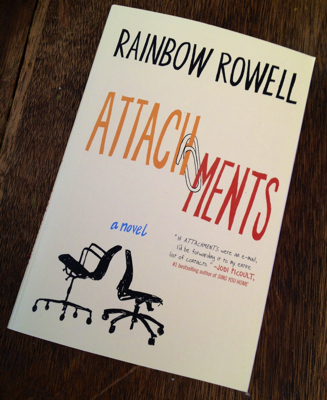
Several months ago, I inherited my grandmother’s Kindle. While I have my fair share of mixed feelings about e-readers, there are some books that are just suited to the quick-click nature of a Kindle. Rainbow Rowell’s Attachments is one of those novels. I absolutely devoured this one–started and finished in less than twenty-four hours. It’s ever so consumable, which makes Attachments the perfect book to take with you poolside or to the beach this summer.

Beth and Jennifer are two friends on the cusp of their thirties, working at their local newspaper. Lincoln is the internet security officer tasked with monitoring the paper’s emails for inappropriate conduct. The girls are constantly breaking the rules by gossiping and sharing personal emails on the company’s time, but Lincoln can’t bring himself to send the pair a warning. Though he feels a dreadful amount of guilt over reading their emails, Lincoln feels a friendly connection towards Beth and Jennifer. His guilt ratchets up another notch when he realizes he’s falling for Beth without ever having met her in person. As Lincoln works up his courage in order to introduce himself, Beth and Jennifer are struggling to figure out what they want from their own lives.


AttachmentsPBBlog


Despite the potentially off-putting topic of company surveillance, Attachments is one of the most adorable office dramas I’ve ever read. Set on the eve of Y2K fever, the novel still captivates those of us trying to define living in the digital era. Making connections through computers is something that many can relate to, though usually not without an online profile. It helps that the characters are also endearingly neurotic. You read their emails or their inner monologues and think to yourself that you’ve been there, you’ve had those conversations.

The chapters are pleasantly short, which enables the novel’s consumable quality. The perspectives alternate between Beth and Jennifer’s emails and Lincoln’s narration. As you read the girls’ emails, you know Lincoln has read them too, making the readers complicit in his prying. In a way, Attachments reminds me of one of my favorite Meg Cabot novels, The Boy Next Door. Cabot’s book is a longer read and is carried out entirely through emails, but the humor is something that both novels share. I snorted, chortled, and cackled through this book. The kind of involuntary laughs that take you by surprise and show that you really enjoyed something.

One of the things I appreciated most about this novel was that it was a coming of age story for all three main characters, and that they’re not teenagers. Too often when we hear the phrase “coming of age” in literature it is applied to teens, and while that may be an accurate experience for some, others take a bit longer to come into their own. At twenty-three, I’m still trying to figure things out for myself, and it was comforting to read about characters in their late twenties doing the same. Lincoln’s still living with his mother, Beth is stuck in a dead-end relationship, and Jennifer is battling the societal pressure to become a mom. Each character makes strides in discovering what it means to be in a family or a relationship, but they make mistakes too. As with life, their mistakes are just as important as their successes.

In terms of trouble spots, I only had one major problem throughout the story. Most authors give you sufficient character description to bring a person to life without being too explicit. Rowell didn’t give me enough physical description, or rather she gave me conflicting descriptions. One character would describe him/herself and it would be laden with their own insecurities. Then the character would be described by another as really attractive. While this duel expression is likely honest to how we see ourselves, it threw me off. I struggled through most of the book to get a firm image of Beth and Lincoln in my mind. Obviously I got through the book just fine, but this one little snag drove me nuts.

At the end of the day, Attachments is fluff. If it were food it would be meringue: melt in your mouth sweet. It’s not enough to fill you up, but you’re glad you ate it. This is Rowell’s first novel, so I’d like to see how she has developed her style since Attachments‘ publication. Her other titles include Eleanor and Park and Fangirl. I’d expect them to be equally engaging.

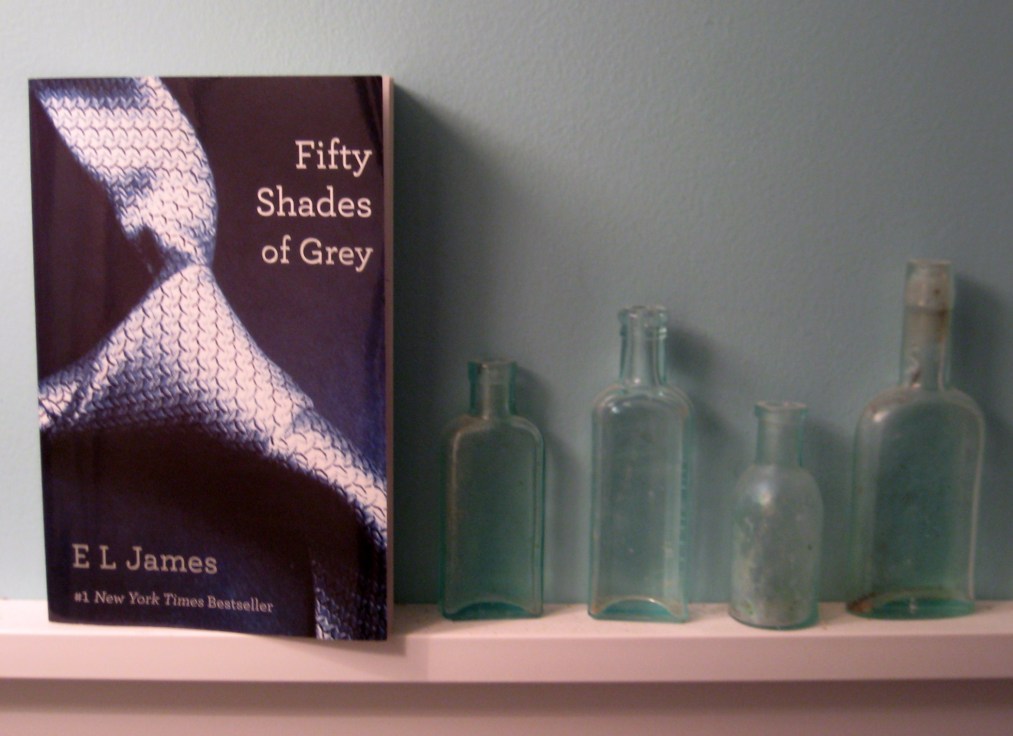
Book Review: Fifty Shades of Grey

Image

There has been so much hype for E. L. James’ Fifty Shades of Grey in the past few months. Many have been quick to label the series as “mommy porn”, and James has been credited with bringing sexy back to books. Both comments floor me as a reader. I love romance novels. They are my not so guilty pleasure. Romance and erotica are not new concepts in the publishing world, so I was irked that mass media seemed to be ignoring many other authors’ mass market successes.

At the same time, I have a strange relationship with mainstream fiction. I always want to resist the book-of-the-moment, but then I get so curious that I cave. Why are certain books so popular? I played this resistance game with Harry Potter (loved), Twilight (Mer), and The Hunger Games (decent). So with all the buzz about Fifty Shades of Grey, I knew I would eventually give in and read the book. When my new read hit my Facebook stream, I got decidedly negative feedback from my friends, which sort of surprised me. After reading the novel, my surprise is gone.

Fifty Shades of Grey follows a recent graduate, Anastasia Steele as she begins a turbulent relationship with demanding entrepreneur, Christian Grey. Ana is innocent and intimidated by Christian’s wealth and cold exterior. Yet, she is equally drawn to Christian’s hidden depths and dark desires. Both Ana and Christian must find the balance between what they want and what they need, or risk falling apart.

Image

Now, when I judge this book it has nothing to do with the BDSM (Bondage, Discipline, Sadism, and Masochism) subculture that’s depicted in Fifty Shades of Grey. That has never bothered me as a reader, and I’ve delved into that world before with some of my favorite romance authors, Emma Holly and Laurell K Hamilton. The sex scenes are well written and keenly balanced. James offers a view in to the realm of BDSM without taking her readers into the culture’s more intimidating intensity. The sex is, in my opinion, the best part of the book. Some may argue that the sex is all a romance reader needs, but there has to be a strong, well-written story to justify a 514 page novel.

I feel compelled to address the fan-fiction history of this series. It’s like The Exorcist: you can’t un-see those  gruesome scenes, and you can’t un-hear that Fifty Shades of Grey was based on Twilight. Even at my most involved with this book, I would recall that Christian Grey is supposed to be Edward Cullen and it would throw me out of the story. Christian exhibits the stalker tendencies that creeped me out with his sparkly counterpart. And while Ana is less dull than Bella Swan, she has the same overwhelming insecurities. Surprise! Both qualities are still off-putting. Though the book doesn’t follow the trajectory of Twilight’s plot exactly, I couldn’t escape the legacy.

James does a decent job of articulating the conflicting emotions that a young girl would face as she enters into an uncertain sexual journey. What hinders the story is an overabundance of telling rather than showing (the ultimate author sin). Ana’s inner monologue often references her Inner Goddess and her Subconscious, and the latter is rather judgmental. The idea could have panned out if the characters were given in small doses. Once the idea is introduced, you can hardly go a page without running into the Inner Goddess or Subconscious. They’re both obnoxious bitches and they ruined the book for me. I wanted to gag them, and not in a way they would find pleasurable. I would have been drawn to Ana’s character more without her Inner Goddess and Subconscious talking for her.

Another element that I thought was overused and abused was the interior reference to “Fifty Shades” found in the title. Christian calls himself “Fifty shades of fucked up”, which if used once or twice would have had more resonance. But after the phrase is said, the floodgates open and suddenly “Fifty Shades” is in nearly every chapter. The more “Fifty Shades” is used, the more the words lose their power.

There were parts of the novel that I enjoyed, but they were overshadowed by what I consider to be errors in storytelling. It doesn’t matter what genre you’re writing in, the story has to be well written. Unless you just want to read it for the sex, I wouldn’t recommend Fifty Shades of Grey. A stubborn part of me wants to finish the series in the hopes that it gets better, but I don’t think I will give in to that impulse.

Book Review: Game of Thrones

“If Tolkien and Dickens had a baby it would be Martin.” –Caitlin McCann (Me)

I recently finished George R. R. Martin’s Game of Thrones and have been recommending this thing like a madwoman. Heck, I was recommending it before I had the whole book finished.

I got into Martin’s A Song of Ice and Fire series because of my friend Chelsey. She kept telling me about this amazing series I had to read. For months I put her pick on the back burner, because as any bibliophile knows, a must-read list quickly becomes an infinite thing. Plus, Game of Thrones is about 800 pages and I was waiting for summer time to read this mammoth at my leisure.

A reader’s tip: I read the appendix first to get a good feel for the characters and the history of Martin’s world. It made me feel more knowledgeable, and I wasn’t constantly flipping to the back of the book.

I also read the book in segments of fifty pages or more because this book is dense (in the best way possible). You have to attack this book or risk defeat. For me, the density is a bonus, but I understand it may not be for everyone. Some of my favorite authors are Tolkien, Irving, and Dickens: all known for their detail and depth.

I rattled off my quote above to my friend Carolyn, as I was making yet another recommendation. Truly, if Tolkien and Dickens had a literary baby it would be George R. R. Martin. Tolkien fans will be drawn to the fantasy element of Game of Thrones. There’s a well-developed backdrop of fantasy that bolsters but doesn’t over-dominate the plot. Dickens lovers will also appreciate Martin’s skill at character development and casual craft of language.

The novel takes awhile to truly pick up in pace, but what will pull readers through the intellectual thicket is the characters. Martin has a talent for connecting readers with his characters. Everyone will have a favorite. Mine are Daenerys Targaryen, the naive but regal young exile, and Tyrion Lannister, the witty and honest dwarf of a noble house. Game of Thrones is composed of small chapters, each told in the voice of one of eight characters. As I writer, I have to give Martin praise for the finesse it takes to balance so many perspectives. He takes on adults, children, men, and women, as well as differences in class. Martin’s gift is that each character is fully developed as if the whole novel was theirs. It’s damn hard, and he makes it look easy.

The multiple perspective format enhances the element of mystery inherent in the story as each character reveals new information that helps the reader piece together the plot. I felt more drawn in to the story because each chapter took me somewhere new. I also appreciated that not every character was pristine and 100% lovable. Some were definitely more likable that others but each is flawed and has to come up against those flaws in some way or another. I thought the characters made the book worth the read. Beware, they will grab you.

Game of Thrones is the first novel in a series, and it sets the tone well for a visual thrill ride full of strong characters. If you’re not already a fan of the HBO series by the same name, then get on that too. The stellar visuals translate beautifully to the small screen, and book purists will be happy to note the TV series follows the novel respectably. [Note: I haven’t seen the second season yet so I can’t pass judgement on it.]

George R. R. Martin has quickly risen to my personal pantheon of favorite authors. I can’t wait to start the next installment, A Clash of Kings. And next time, I’ll be moving Chelsey’s picks to the front of the line.